
Custom Healthcare Software Development Guide
By Eugen Yamamoto, Founder of CQUELLE

Why Healthcare Organizations Are Moving Beyond Off-the-Shelf Software
The healthcare industry is at a tipping point. Generic, off-the-shelf software simply cannot keep up with the regulatory complexity, interoperability demands, and patient-centric expectations that modern providers face. As a result, hospitals, clinics, and health-tech startups are increasingly investing in custom healthcare software development to gain a competitive edge and deliver better care.
According to Grand View Research, the global healthcare IT market is expected to reach $974.5 billion by 2030. A significant share of that growth is driven by organizations that choose purpose-built solutions over generic platforms that require endless workarounds.
But what does custom healthcare software actually look like? And how do you build it without running afoul of regulations like HIPAA? This guide covers everything you need to know.
Types of Custom Healthcare Software
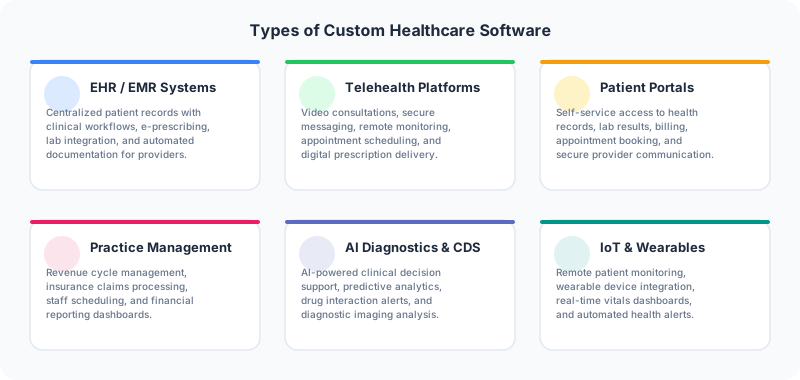
Before diving into the development process, it helps to understand the range of solutions that fall under the custom healthcare software umbrella.
EHR and EMR Systems
Electronic Health Record (EHR) and Electronic Medical Record (EMR) systems are the backbone of modern healthcare. While commercial options like Epic and Cerner exist, many organizations build custom EHR modules to address gaps in their workflows — such as specialty-specific documentation, proprietary clinical protocols, or unique reporting requirements.
A custom EHR can integrate scheduling, e-prescribing, lab results, and clinical notes into a single, unified interface tailored to how your clinicians actually work.
Telehealth Platforms
The telehealth market exploded during the pandemic and has continued to grow. Custom telehealth solutions go beyond simple video calls. They include secure messaging, remote patient monitoring, digital prescription delivery, and integration with existing EHR systems — all under a single, branded experience.
Patient Portals
Patient engagement is a top priority for value-based care models. Custom patient portals give individuals self-service access to their health records, lab results, billing history, and appointment scheduling, while maintaining HIPAA-compliant communication channels with their care teams.
Practice Management Software
Revenue cycle management, insurance claims processing, staff scheduling, and financial reporting — these operational tasks are critical but vary enormously from one practice to another. Custom practice management software eliminates the compromises that come with generic solutions.
AI-Powered Clinical Decision Support
Artificial intelligence is transforming diagnostics. Custom clinical decision support (CDS) systems leverage machine learning to provide drug interaction alerts, predictive risk scoring, diagnostic imaging analysis, and evidence-based treatment recommendations — all integrated directly into the clinician's workflow.
IoT and Remote Patient Monitoring
Wearable devices and connected medical equipment generate a continuous stream of patient data. Custom software aggregates this data, presents real-time dashboards, triggers automated alerts when vitals fall outside safe ranges, and feeds insights back into the patient's medical record.
The Development Process: From Discovery to Deployment
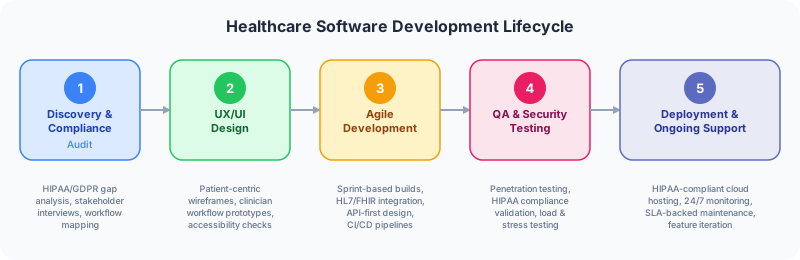
Building healthcare software requires a structured, compliance-first approach. Here is the process that leading development teams follow.
Step 1: Discovery and Compliance Audit
Every healthcare software project starts with understanding the regulatory landscape. This means conducting a HIPAA gap analysis (or GDPR if serving European patients), mapping existing clinical workflows, interviewing stakeholders across departments, and identifying integration points with existing systems.
This phase prevents costly rework later. Skipping it is the single biggest mistake organizations make.
Step 2: UX/UI Design
Healthcare software has a unique design challenge — it must serve multiple user types simultaneously. A patient portal needs to be simple and accessible. A clinician dashboard needs to surface critical information instantly without cognitive overload. An admin console needs comprehensive reporting without unnecessary complexity.
Patient-centric wireframes, clinician workflow prototypes, and accessibility audits (WCAG 2.1 compliance) are essential deliverables at this stage.
Step 3: Agile Development
Sprint-based development allows healthcare organizations to see working software early and often. Key technical considerations include:
- HL7 and FHIR integration for interoperability with other healthcare systems
- API-first architecture to enable modular expansion
- CI/CD pipelines for safe, frequent deployments
- Microservices architecture to isolate critical modules and scale independently
Step 4: QA and Security Testing
Healthcare software demands a higher standard of testing than most industries. In addition to functional and regression testing, teams must conduct:
- Penetration testing to identify security vulnerabilities
- HIPAA compliance validation including PHI access controls
- Load and stress testing to ensure reliability during peak usage
- Disaster recovery testing to verify backup and failover systems
Step 5: Deployment and Ongoing Support
Deployment to a HIPAA-compliant cloud environment (AWS GovCloud, Azure Healthcare, or Google Cloud Healthcare API) is just the beginning. Ongoing support includes 24/7 monitoring, SLA-backed maintenance, security patch management, and iterative feature development based on user feedback.
Architecture: What Makes Healthcare Software Different
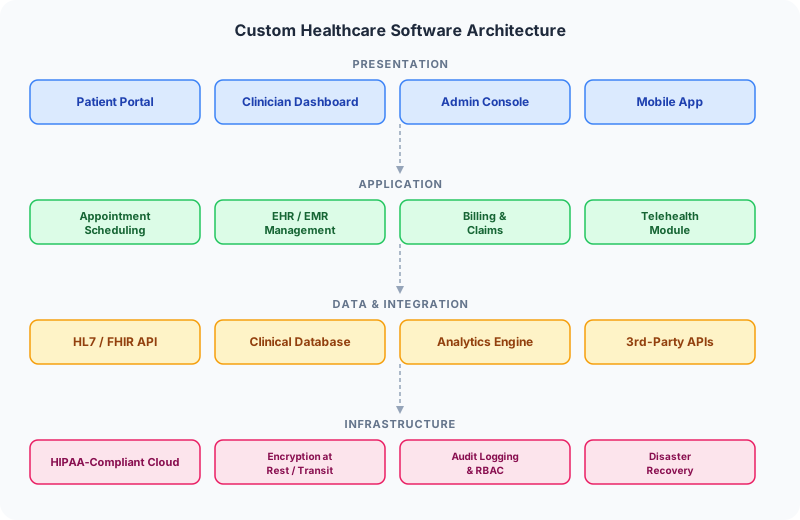
Healthcare software architecture must prioritize three things above all: security, interoperability, and scalability.
Security and Compliance
Every layer of the architecture must enforce HIPAA's technical safeguards:
- Encryption at rest and in transit (AES-256 and TLS 1.3)
- Role-based access control (RBAC) to ensure clinicians, administrators, and patients see only what they should
- Comprehensive audit logging that tracks every access to Protected Health Information (PHI)
- Automated session management with configurable timeout policies
Interoperability
Healthcare data is notoriously siloed. Custom software bridges these silos through:
- HL7 v2 and FHIR R4 APIs for structured clinical data exchange
- DICOM integration for medical imaging
- X12 EDI transactions for insurance claims and eligibility checks
- Integration with pharmacy networks, labs, and public health registries
Scalability
A platform that works for a 10-provider clinic must also work for a 500-provider health system. Cloud-native architecture with containerized microservices, auto-scaling, and database sharding ensures that performance remains consistent as usage grows.
How Much Does Custom Healthcare Software Cost?
Cost varies widely depending on scope, but here are realistic ranges:
- MVP / proof of concept: $50,000 – $150,000
- Mid-complexity platform (e.g., custom patient portal with EHR integration): $150,000 – $500,000
- Enterprise-grade system (e.g., full EHR + telehealth + analytics): $500,000 – $2,000,000+
The key factor is not the initial build cost — it is the total cost of ownership. Custom software eliminates per-seat licensing fees, reduces manual workarounds, and adapts to your needs without waiting for a vendor's product roadmap.
When Should You Choose Custom Over Off-the-Shelf?
Custom healthcare software makes sense when:
- Your workflows are unique and no commercial product supports them without significant customization
- Interoperability is critical and you need to connect systems that were never designed to talk to each other
- You need full control over your data, security posture, and compliance documentation
- Scalability matters and you cannot afford vendor lock-in or per-seat pricing as you grow
- Patient experience is a differentiator and you want a branded, seamless digital experience
Conversely, if your needs are straightforward and align well with a major platform, an off-the-shelf solution may be the faster path. The decision should always be driven by your specific clinical and business requirements.
Real-World Impact: What Custom Software Delivers
Healthcare organizations that invest in custom software consistently report:
- 30-40% reduction in administrative burden through workflow automation
- Improved patient satisfaction scores from seamless digital experiences
- Faster insurance claim processing with fewer denials through automated validation
- Better clinical outcomes from AI-assisted decision support and real-time monitoring
- Reduced compliance risk through purpose-built security controls and audit trails
Choosing the Right Development Partner
Not every software development company understands healthcare. When evaluating partners, look for:
- Demonstrated healthcare experience — ask for case studies with HIPAA-compliant systems
- Compliance expertise — the team should understand HIPAA, HITECH, and relevant state regulations
- Interoperability skills — experience with HL7, FHIR, DICOM, and healthcare API standards
- Security-first mindset — penetration testing, encryption, and audit logging should be standard practice
- Post-launch support — healthcare software requires ongoing monitoring, updates, and compliance maintenance
At CQUELLE, we specialize in building custom healthcare software that meets the highest standards of security, compliance, and usability. Our team has hands-on experience with HIPAA-compliant architectures, EHR integrations, and patient-facing platforms.
Ready to Build?
Custom healthcare software development is not a luxury — it is a strategic investment that directly impacts patient outcomes, operational efficiency, and regulatory compliance. Whether you are building an MVP to validate a health-tech concept or modernizing a legacy system for a hospital network, the right approach starts with understanding your unique requirements.
Get in touch with our team to discuss your healthcare software project. We will help you define the scope, estimate costs, and chart a path from concept to compliant, production-ready software.
Frequently Asked Questions
What types of custom healthcare software can be built?
Custom healthcare software covers several categories: EHR and EMR systems for clinical records, telehealth platforms with secure messaging and remote monitoring, patient portals for self-service access to records and scheduling, practice management software for revenue cycle and claims, AI-powered clinical decision support for alerts and risk scoring, and IoT and remote patient monitoring that aggregates data from wearable and connected medical devices.
What does HIPAA require in healthcare software architecture?
Every layer of healthcare software architecture must enforce HIPAA's technical safeguards. These include encryption at rest and in transit (such as AES-256 and TLS 1.3), role-based access control so clinicians, administrators, and patients see only what they should, audit logging that records every access to Protected Health Information (PHI), and automated session management with configurable timeout policies.
How do healthcare systems achieve interoperability?
Custom healthcare software bridges siloed data using established standards. HL7 v2 and FHIR R4 APIs handle structured clinical data exchange, DICOM integration handles medical imaging, and X12 EDI transactions cover insurance claims and eligibility checks. Software can also integrate with pharmacy networks, labs, and public health registries, letting systems that were never designed to communicate exchange data reliably.
How much does custom healthcare software cost?
Cost varies by scope. A healthcare MVP or proof of concept runs roughly $50,000–$150,000, a mid-complexity platform such as a custom patient portal with EHR integration runs $150,000–$500,000, and an enterprise-grade system combining full EHR, telehealth, and analytics runs $500,000–$2,000,000 or more. The key factor is total cost of ownership, since custom software eliminates per-seat licensing fees and manual workarounds.
When should a healthcare organization choose custom software over off-the-shelf?
Custom healthcare software makes sense when your clinical workflows are unique and no commercial product supports them without heavy customization, when interoperability between systems is critical, when you need full control over data and compliance documentation, when scalability matters and you want to avoid vendor lock-in or per-seat pricing, or when patient experience is a differentiator. If your needs align well with a major platform, off-the-shelf may be faster.