
Custom Software Development Services: A Guide
By Eugen Yamamoto, Founder of CQUELLE

Why Getting This Decision Right Matters More Than You Think
Choosing a custom software development partner is one of the highest-stakes decisions a business can make. The wrong choice does not just waste budget — it burns months of opportunity cost, creates technical debt that haunts you for years, and can leave you with a product that your team refuses to use.
Yet most companies make this decision based on little more than a sales pitch and a price comparison. According to the Standish Group, 66% of software projects either fail or are "challenged" — and a significant portion of those failures trace back to choosing the wrong development partner.
This guide gives you a structured framework for evaluating custom software development services providers, so you can make a confident, informed decision.
What Custom Software Development Services Actually Include
Before evaluating providers, it helps to understand what a full-service custom software development company should offer. The best partners provide end-to-end capabilities across the entire software lifecycle:
- Discovery and requirements engineering — translating business problems into technical specifications
- UX/UI design — creating interfaces that users actually want to use
- Application development — building the software using modern frameworks and best practices
- Quality assurance — functional, performance, and security testing
- DevOps and cloud infrastructure — CI/CD pipelines, deployment, and environment management
- Post-launch support — maintenance, monitoring, and iterative improvement
Some providers specialize in one or two of these areas. Others offer the full stack. The right choice depends on your internal capabilities and what gaps you need filled.
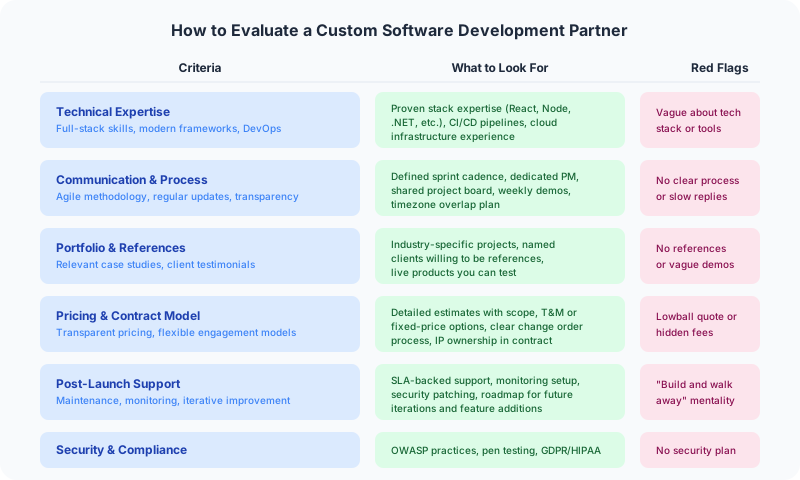
The 7-Point Evaluation Framework
After working with dozens of organizations navigating this decision, we have identified seven criteria that consistently separate great development partners from mediocre ones.
1. Technical Expertise That Matches Your Needs
A provider's tech stack should align with your project requirements — not the other way around. If you need a React and Node.js application, do not hire a team whose entire portfolio is built in PHP.
What to ask:
- What technologies do you recommend for our use case, and why?
- Can we speak with your senior engineers before signing?
- How do you stay current with framework updates and security patches?
- What does your CI/CD and deployment pipeline look like?
Watch for: Companies that claim to be experts in everything. A team that says they are equally proficient in 15 languages and 30 frameworks is likely mediocre at all of them. The best providers have deep expertise in a focused set of technologies and are honest about what falls outside their sweet spot.
2. A Proven Track Record in Your Industry
Generic software development experience is necessary but not sufficient. A team that has built fintech applications understands PCI compliance, transaction processing, and real-time data. A team that has only built marketing websites does not.
What to ask:
- Can you share case studies from projects in our industry?
- What domain-specific challenges did you encounter, and how did you solve them?
- Are any of your previous clients willing to serve as references?
Watch for: Providers who show you flashy designs but cannot explain the business logic behind them. The visual layer is the easy part — what matters is whether they understand the workflows, regulations, and data models that drive your industry.
3. Communication and Project Management
Poor communication is the number one cause of failed software projects. It does not matter how talented the engineering team is if you cannot get a straight answer about project status.
What to ask:
- What project management methodology do you follow?
- How often will we receive status updates?
- Who is our primary point of contact, and what is their availability?
- What tools do you use for project tracking and communication?
- How do you handle timezone differences?
The non-negotiables:
- A dedicated project manager (not a developer splitting their time)
- Weekly sprint demos where you see working software
- A shared project board (Jira, Linear, or similar) with full transparency
- Defined escalation paths when issues arise
4. Engagement Model Flexibility
There is no one-size-fits-all engagement model. The right structure depends on your project's scope, timeline, and how clearly you can define requirements upfront.
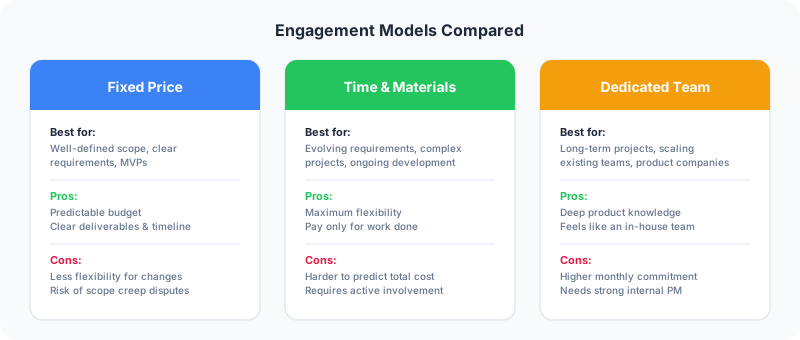
Fixed price works well for projects with clearly defined scope — an MVP, a migration, or a standalone tool where the requirements are unlikely to change significantly.
Time and materials is better for complex, evolving projects where you need the flexibility to adjust priorities as you learn more. You pay for actual hours worked, which gives you maximum control over direction.
Dedicated team makes sense for long-term product development. You effectively hire a remote extension of your team that builds deep product knowledge over time.
The best providers offer all three models and help you choose based on your situation rather than pushing whichever model maximizes their revenue.
5. Transparent Pricing and Contracts
Software development pricing varies enormously across providers. A project quoted at $50,000 by one company may be quoted at $300,000 by another — and neither price may be wrong. What matters is understanding exactly what you are paying for.
What to demand:
- A detailed breakdown of costs by phase (discovery, design, development, QA, deployment)
- Clear definition of what is included and what triggers additional costs
- A documented change order process for scope modifications
- IP ownership explicitly stated in the contract — you should own everything that is built for you
- Source code access from day one, not just at project completion
Red flags:
- Estimates that feel too low — they are either cutting corners or planning to charge you later
- Refusal to provide fixed estimates even for well-defined phases
- Contracts that retain IP ownership with the development company
- Vague line items like "project management overhead" without hours attached
6. Security Practices and Compliance
Every custom software application handles sensitive data — whether it is customer information, financial records, or proprietary business logic. Your development partner's security practices directly impact your risk exposure.
What to verify:
- Do they follow OWASP Top 10 guidelines as a baseline?
- Is security testing (SAST, DAST, dependency scanning) integrated into the CI/CD pipeline?
- How do they handle secrets management and environment configuration?
- Can they demonstrate compliance with relevant regulations (GDPR, HIPAA, SOC 2, PCI DSS)?
- What is their incident response process if a vulnerability is discovered?
Minimum expectations: Code reviews on every merge request, automated security scanning, encrypted data at rest and in transit, and role-based access control. These are table stakes, not differentiators.
7. Post-Launch Support and Long-Term Partnership
Launching software is not the finish line — it is the starting line. The first version of any product reveals user behaviors and needs that no amount of planning can predict. Your development partner should be prepared for the long game.
What to ask:
- What does your post-launch support look like?
- Do you offer SLA-backed maintenance agreements?
- How do you handle production incidents and emergency fixes?
- What is your approach to ongoing feature development and iteration?
The best partners proactively monitor application performance, suggest improvements based on usage data, and treat your product as if it were their own. The worst ones consider the project "done" the moment it goes live.
Typical Timeline: What to Expect
Understanding realistic timelines helps you set proper expectations and identify providers who are either overpromising or padding their estimates.
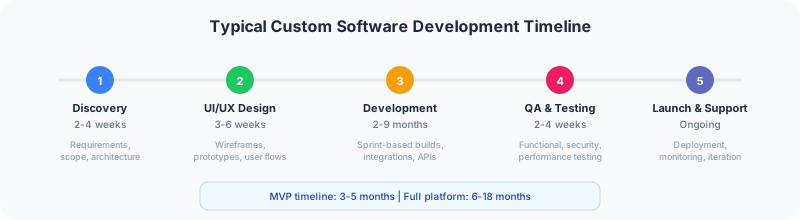
- Discovery phase (2-4 weeks): Requirements gathering, architecture planning, and technical specification
- UI/UX design (3-6 weeks): User research, wireframes, interactive prototypes, and design system creation
- Development (2-9 months): Sprint-based building, with deployable increments every 2 weeks
- QA and testing (2-4 weeks): Overlaps with development in good teams, with final regression and performance testing before launch
- Launch and support (ongoing): Deployment, monitoring setup, and iterative improvement
An MVP typically takes 3-5 months. A full enterprise platform takes 6-18 months. Any provider who promises to build a complex application in 4 weeks is either underestimating scope or planning to deliver something unusable.
How Much Do Custom Software Development Services Cost?
Cost depends on team location, project complexity, and engagement model. Here are realistic ranges based on current market rates:
- Onshore (US/Western Europe): $100–$200/hour
- Nearshore (Eastern Europe, Latin America): $30–$55/hour
- Offshore (South/Southeast Asia): $18–$40/hour
By project type:
- MVP / proof of concept: $30,000 – $100,000
- Mid-complexity application (custom CRM, patient portal, internal tool): $100,000 – $400,000
- Enterprise platform (multi-module, integrations, high availability): $400,000 – $2,000,000+
The cheapest option is almost never the best value. Factor in communication overhead, rework rates, and the cost of fixing quality issues when comparing providers at different price points. A nearshore team at $80/hour that delivers clean code on the first pass is dramatically cheaper than an offshore team at $30/hour that requires two rounds of rework.
The Vendor Selection Process: Step by Step
Here is a practical process for selecting your custom software development partner:
- Define your requirements — Even a rough scope document helps providers give meaningful estimates. Include business goals, target users, key features, integrations, and compliance needs.
- Create a shortlist of 3-5 providers — Use industry directories (Clutch, GoodFirms), referrals, and case study research to identify candidates with relevant experience.
- Send an RFP or detailed brief — Give each provider the same information and ask for a proposal that includes approach, timeline, team composition, and estimated cost.
- Conduct technical interviews — Do not just talk to salespeople. Meet the engineers and architects who will actually work on your project. Ask them to walk through how they would approach your specific challenge.
- Check references — Call previous clients. Ask about communication quality, adherence to timelines, how the team handled unexpected challenges, and whether they would hire them again.
- Start with a paid discovery phase — Before committing to a full build, engage your top candidate for a 2-4 week discovery phase. This is the fastest way to validate that the working relationship functions before you are locked in.
Questions to Ask Before Signing
Keep this checklist handy during your evaluation:
- Who specifically will work on our project, and what is their experience?
- What happens if a key team member leaves mid-project?
- How do you handle scope changes and what triggers additional costs?
- Who owns the intellectual property — code, designs, documentation?
- Can we access the source code repository from day one?
- What is your average project completion rate on time and on budget?
- How do you ensure knowledge transfer if we decide to bring development in-house?
Why Companies Choose CQUELLE
At CQUELLE, we approach custom software development as a partnership, not a transaction. Our team has delivered tailored software solutions across healthcare, fintech, logistics, and enterprise SaaS — always with a focus on clean architecture, transparent communication, and long-term maintainability.
What sets us apart:
- Senior-only engineering teams — no juniors learning on your project
- Full transparency — shared project boards, weekly demos, and direct access to your development team
- Flexible engagement models — fixed price, time and materials, or dedicated teams based on what fits your needs
- Post-launch ownership — we do not disappear after deployment. Our support agreements include monitoring, security updates, and iterative feature development
Schedule a free consultation to discuss your project. We will help you define scope, estimate costs, and determine whether we are the right fit — no pressure, no obligation.
Frequently Asked Questions
What do custom software development services include?
Full-service custom software development covers the whole lifecycle: discovery and requirements engineering, UX/UI design, application development (commonly .NET on the backend with React or Angular on the frontend), functional, performance, and security testing, DevOps and CI/CD pipelines, and post-launch maintenance. Some providers do only one or two of these. Others do all of them. The right choice depends on which gaps you actually need filled.
What are the main software development engagement models?
There are three common engagement models. Fixed price suits projects with clearly defined scope, such as an MVP or a migration. Time and materials fits complex, evolving projects where you pay for actual hours worked and keep flexibility over direction. A dedicated team works for long-term product development, where you hire a remote extension of your team that builds deep product knowledge over time.
How much do custom software development services cost?
Cost depends on team location, project complexity, and engagement model. Typical hourly rates run $100–$200 onshore (US/Western Europe), $30–$55 nearshore (Eastern Europe, Latin America), and $18–$40 offshore (South/Southeast Asia). By project type, an MVP runs roughly $30,000–$100,000, a mid-complexity application $100,000–$400,000, and an enterprise platform $400,000–$2,000,000 or more.
How long does it take to build custom software?
A custom software MVP typically takes 3–5 months, while a full enterprise platform takes 6–18 months. A common timeline breaks down into discovery (2–4 weeks), UI/UX design (3–6 weeks), development (2–9 months in two-week sprints), and QA and testing (2–4 weeks), followed by ongoing launch and support. Any provider promising a complex application in 4 weeks is underestimating scope.
Who should own the intellectual property in a custom software contract?
You should own everything built for you. In a custom software development contract, IP ownership should be stated explicitly, and you should have source code access from day one rather than only at project completion. A contract that retains IP ownership with the development company is a red flag, as are vague line items and refusal to provide fixed estimates for well-defined phases.