
Custom Software Development Cost in 2026: The Arithmetic
By Eugen Yamamoto, Founder of CQUELLE

Custom software development cost with a European team, in the ranges the market produces: €80,000–120,000 for a focused MVP (3–4 people, about four months), €200,000–360,000 for a mid-size product (4–5 people, 6–9 months), and from €450,000 when a build or modernization needs 6–8 people for a year or more. The math is short enough to redo on a napkin: team size × months × the monthly rate per developer. (CQUELLE itself prices differently since September 2026: per accepted story, not per team-month. This article is about the market arithmetic, which you need to read any quote, ours included.)
Where does the confidence in those team sizes and months come from? Estimation habits, not gut feel. Before we quote, the work is broken down the way our engineering handbook requires for delivery itself: stories capped at 20 hours, split into sub-tasks of two hours or less. An estimate assembled from two-hour pieces can be checked, challenged line by line, and compared against what actually ships in week one. Vendors quoting from gut feel can only defend a number with adjectives.
What custom software development costs in 2026
Three project sizes cover most of what mid-size companies commission. All ranges are quote-level: design, testing, code review, and coordination are inside them, because software without those is not cheaper, it is unfinished.
Focused MVP: €80,000–120,000
Two or three developers plus a shared designer/QA, roughly four months. One core workflow done properly: a customer portal, an internal tool replacing a spreadsheet process, the first version of a product. The budget's job at this size is proving the idea in production while the exit costs stay low.
Mid-size product: €200,000–360,000
Four to five people for six to nine months. This is where most serious internal platforms and B2B products live: multiple user roles, integrations with the systems you already run, automation with a human review step. The range is wide because lever two below — integrations — varies more at this size than anything else.
Large build or modernization: from €450,000
Six to eight people, a year or more, shipped in slices so value arrives quarterly rather than at the end. Legacy replacement, multi-system integration, regulated-industry platforms. At this size the slicing itself is the cost control: every slice can be tested on its own and cancelled on its own.
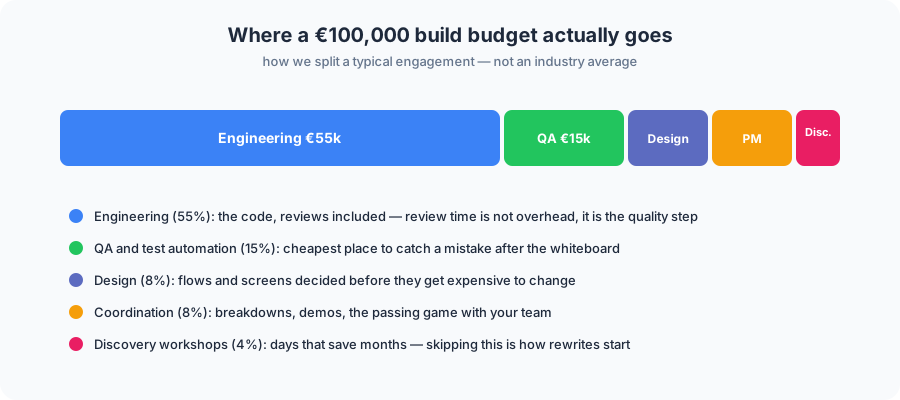
The split matters as much as the total. Engineering is a little over half; the rest is what makes the engineering land — QA, design, coordination, discovery. When a cheaper quote arrives, this diagram is where the difference usually hides: the total shrank because a slice you will need anyway was left out.
Rates by region, and what a rate buys
Every estimate reduces to people × time × rate, so the comparison between vendors starts at the rate band.
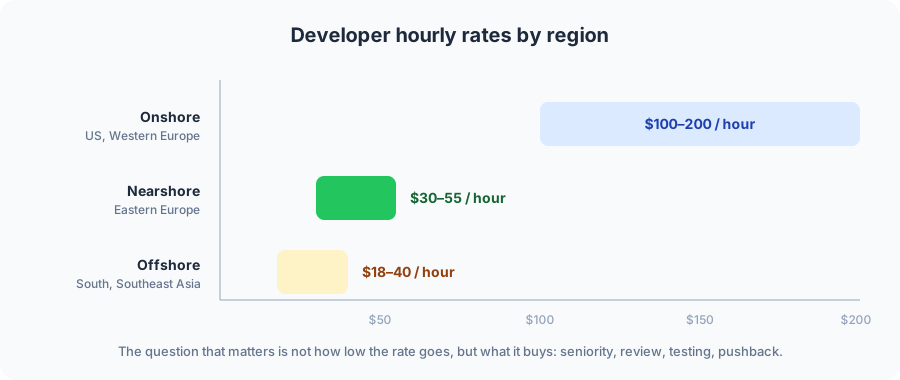
Onshore teams in the US and Western Europe run $100–200 per hour. Offshore teams in South and Southeast Asia run $18–40. Between them sits the Eastern European band at $30–55 per hour, which converts to a monthly seat price on a dedicated-team basis well below the same seniority on a German payroll, in the same time zones as your working day.
A rate is a price tag on a process, not on a person. What sits inside it varies enormously: senior engineers or a bench of juniors under one senior name, code review as routine or as a paid extra, test automation or "we test before release". The questions that expose the difference take one phone call. A $25/hour quote that produces code your next vendor rewrites was never cheap.
Five levers that move the price
- Scope discipline. The must-have list versus everything mentioned in the kickoff. The cheapest feature is the one you agree not to build, and splitting must from nice before the estimate routinely takes a serious slice off the first release.
- Integrations and legacy. A greenfield app is the easy case. Connecting to an ERP from 2009, undocumented internal systems, or a partner's API with no sandbox adds months — and is usually the actual point of the project. Name every system that has to be touched, and the estimate sharpens immediately.
- Compliance. Health data, payments, audit trails, data residency: in regulated industries these belong inside the architecture from day one. Budget them explicitly, and be suspicious of quotes that treat compliance as a phase-two topic.
- The quality step. Review, testing, staging environments. Cut it and the price falls while the cost moves downstream, into production incidents and the rewrite.
- AI acceleration, with judgment. Used properly, AI development tools shorten delivery timelines by up to 40% on suitable work, and that shows up in fewer team-months. What AI does not shrink: deciding what to build, reviewing what it wrote, and integrating with the systems from lever two. A vendor promising AI halves the price is discounting exactly the parts that keep the quality.
There is a sixth lever nobody puts on a slide: not building. If the workflow is standard — bookings, invoicing, a plain CRM — an off-the-shelf tool at €200 a month beats any custom build, and a vendor who never says so is optimizing for their revenue, not your problem. Custom earns its price where the workflow is specific to how you win business; our insurance guide walks that decision for one industry in detail.
Budget lines missing from most quotes
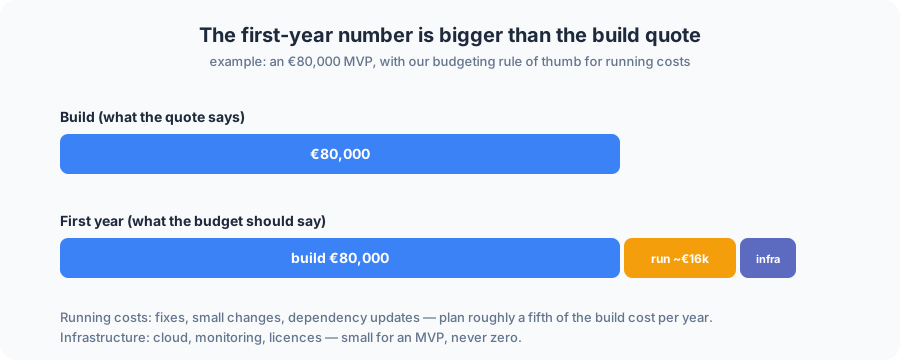
Running costs come first. Our budgeting rule from operating long-lived systems: plan roughly a fifth of the build cost per year for fixes, small improvements, and dependency updates, plus infrastructure — cloud, monitoring, licences. An €80,000 MVP is a €95,000–100,000 first-year commitment, and pretending otherwise just moves the money into next year's emergency.
Your own time is the second hidden line. A build without an internal owner who answers questions weekly drifts toward whatever the vendor found easiest to assume. Plan a few hours a week of a decision-maker's calendar; it is the cheapest quality assurance available.
Rework is the third, and the largest cost most budgets never see, because it is what a too-good quote converts into: the €40,000 build followed by a rewrite that costs more than building it right would have. If two quotes differ by half, the likeliest explanation is that they describe different amounts of finished.
Getting a real custom software development cost for your project
We turn the inputs below into a range in a half-hour call — the same math this article shows, with your numbers in it, and "an off-the-shelf tool covers this" is an answer we give when it is true. A dedicated team starts 2–4 weeks after that call.
What to bring:
- The workflow, written down, even on one page. If two people on your team describe it differently, resolve that before anyone estimates it.
- The must-have list, separated from the nice-to-haves, with the pain each must-have removes.
- The name of your internal owner: the person with a few weekly hours and the authority to decide.
Frequently Asked Questions
How much does custom software development cost?
With a European team at typical market rates: a focused MVP (3–4 people, about 4 months) costs €80,000–120,000; a mid-size product build (4–5 people, 6–9 months) €200,000–360,000; a larger build or modernization (6–8 people, 12+ months) starts around €450,000. The math is team size × months × monthly rate, and any vendor should be able to show it to you the same way.
Why do quotes for the same software project differ so much?
Because vendors quote different projects off the same brief. The main variables: how much scope they assumed (must-haves versus everything mentioned), seniority mix, whether testing and code review are included or billed as extras, region (onshore rates run $100–200/hour against $30–55 nearshore), and how much rework risk is priced in. A quote far below the others usually means scope or quality was quietly removed — you pay for it later as rework.
What are software developer rates by region?
Rates cluster in three bands: roughly $100–200 per hour onshore (US and Western Europe), $30–55 per hour nearshore (Eastern Europe), and $18–40 per hour offshore (South and Southeast Asia). On a monthly dedicated-team basis the nearshore band converts to a monthly seat price that sits well below the same seniority hired in-house in Germany; the exact figure depends on role and seniority.
How much does software maintenance cost per year?
Our budgeting rule of thumb from running long-lived systems: plan roughly a fifth of the build cost per year for fixes, small changes, and dependency updates, plus infrastructure (cloud, monitoring, licences) — small for an MVP, never zero. An €80,000 build is realistically a €95,000–100,000 first-year commitment. Software with no maintenance budget does not stay the same; it quietly degrades until an urgent, expensive intervention.
Does AI make custom software development cheaper?
Used with judgment, yes: AI development tools can accelerate delivery timelines by up to 40% on suitable work, which shows up as fewer team-months for the same scope. It does not remove the expensive parts — deciding what to build, reviewing code, testing, and integrating with existing systems — and a vendor promising AI will cut the price in half is discounting exactly the steps that keep the quality.