
Nearshore Software Development, Shown as One Working Week
By Eugen Yamamoto, Founder of CQUELLE

Nearshore software development means your development team sits in a nearby time zone, not a cheap distant one: for a German company, typically Ukraine, Poland, Romania, or Estonia — zero to one hour from CET, about seven shared working hours a day, at $30–55 per hour instead of the $100–200 onshore band. We run this model daily from Hamburg, with distributed teams in all four countries. The clearest way to explain what you are buying is a week, not a definition.
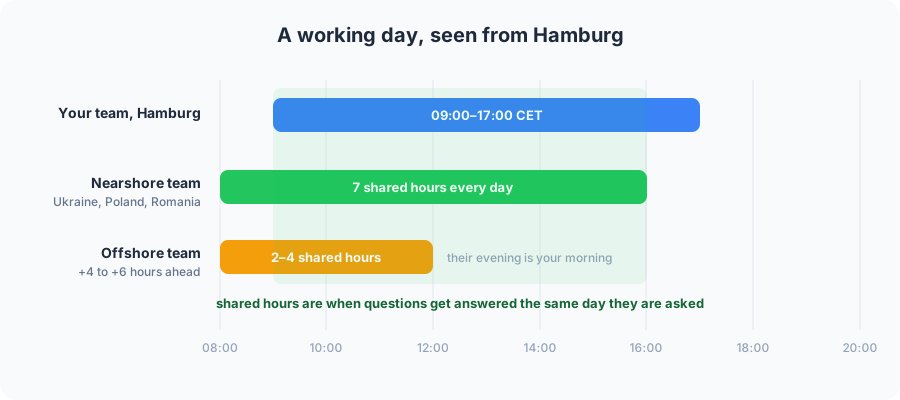
The diagram above is the entire premise. A team one time zone away lives inside your working day; a team six zones away visits it for two hours. Everything below — the breakdown, the passing game, the Friday demo — either works or fails on those shared hours.
Monday, 10:00: the breakdown
A new story lands: say, invoice reminders for a customer portal. Nothing is estimated yet. The developer who will own it prepares a first draft of the task breakdown alone, then finishes it with a colleague — deliberately while everyone is still online, because our own hard-won lesson from years of distributed work is that coordination debt compounds fastest when working hours only partially align. The public version of our engineering handbook states the rule plainly: task breakdown happens every time, before the story starts.
The output looks unglamorous: a story sized to finish within the week, divided into pieces no longer than two hours, each one delivering something a non-technical user can see. The discipline pays for itself the first time it catches a wrong assumption early. Caught at breakdown on Monday, a wrong assumption costs the call it was caught in; caught in a demo three weeks later, it costs the three weeks.
Tuesday to Thursday: the passing game
Mid-week is where nearshore either earns its rates or turns into ticket-tossing. The tasks from Monday run in parallel rather than as one long chain, so there is always a functional version growing — features stack on top of working software instead of arriving as one integration bang at the end.
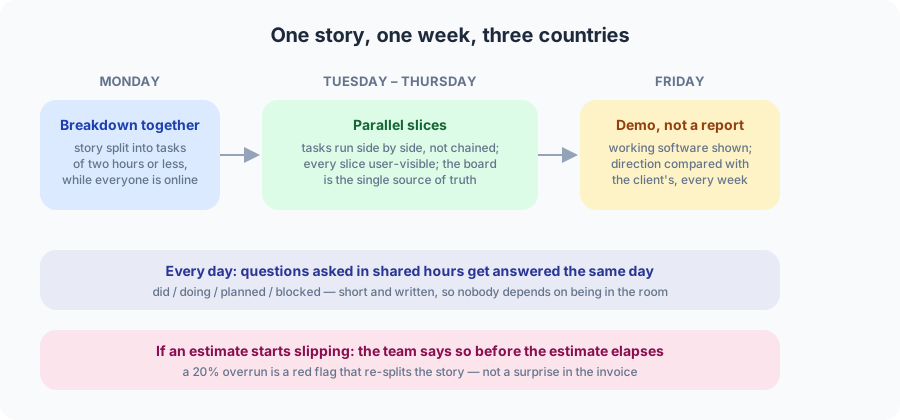
Communication runs on two habits. First, the board is the single source of truth: every task, in its real status, visible to the client at any hour without asking anyone. Second, short written updates — did, doing, planned, blocked — so that state lives in text, not in someone's memory of a call. When a question comes up, it gets asked immediately in chat rather than saved for a meeting; in seven shared hours, an immediate question is an answered question. Our internal lessons-learned page opens, verbatim, with "Ask first per slack whenever possible" — lowercase s and all, the kind of rule a team only writes down after learning it the slow way.
The habit that surprises clients most: if a story starts running past its estimate, the team says so before the estimate elapses, and an overrun beyond roughly 20% triggers a re-split of the story rather than a quiet marathon. Nearshore's bad reputation — where it is deserved — comes from teams that report problems in the invoice. The fix is not geography. It is alerting rules.
Friday, 15:00: the demo
The week closes with working software on a screen, not a status report. A demo does two jobs at once: it proves progress in the only currency that cannot be faked, and it compares the team's direction with yours while the correction is still cheap. Driving at a slightly wrong angle ends far from the destination no matter how well anyone drives. The weekly demo is the steering check.
Fridays also produce the artifact that makes distributed teams resilient: decisions written down. With work on the board, decisions in text, and code in repositories the client owns, no single person — and no single city — is a point of failure. Our teams span Ukraine, Poland, Romania, and Estonia by design; the same discipline that lets a colleague pick up a story lets a whole project route around a bad week in one location.
Why nearshore software development from Eastern Europe works
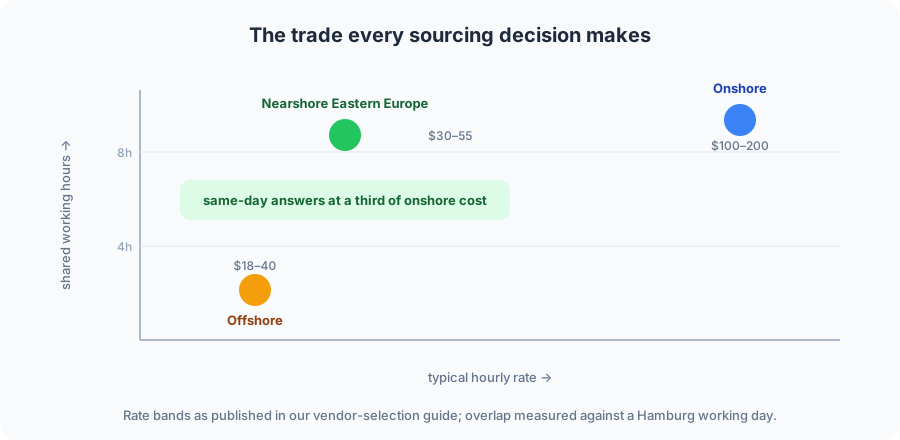
The scatter is the strategic picture: onshore buys overlap at $100–200 per hour, offshore buys rates at $18–40 with 2–4 shared hours, and Eastern European nearshore sits in the corner that matters for iterative work — same-day answers at $30–55 per hour, which on a dedicated basis converts to a monthly seat well below a German payroll.
Three less-quantifiable reasons the region fits German and European buyers. The engineering talent pools in Ukraine, Poland, Romania, and Estonia are deep, with long experience in the stacks European mid-market companies actually run — .NET, React, and the major cloud platforms among them. Poland, Romania, and Estonia are EU members, so GDPR applies directly rather than through contractual gymnastics, and data can stay in EU regions end to end. And the working culture is direct: pushback arrives as pushback, not as a yes that means no, which matters more than any rate once your architecture depends on someone telling you an idea is bad.
For the full cost picture — what builds of different sizes run, maintenance, the levers that move quotes — see our custom software development cost guide; this article's job is the model, not the invoice.
Where nearshore software development breaks, and what prevents it
Every failure mode we have seen in nearshoring has the same root: distance used as an excuse to stop communicating like one team. The prevention is boringly specific. Treating the remote team as ticket-takers fails; giving them the actual business problem in the Monday breakdown works. A board that flatters reality fails; statuses that a client can check at midnight work. An internal side without a decision-maker fails; an owner with a few weekly hours works. None of these are special nearshore practices — just software practices that distance makes non-optional.
If your working style depends on everyone being in one room — daily whiteboard sessions, decisions made in hallways and never written down — fix that first or stay onshore; a nearshore team will faithfully implement the ambiguity it receives.
Trying the model
The cheap experiment beats the big contract: a dedicated team assembles in 2–4 weeks, takes one real, scoped story, and runs it through exactly the week described above. Judge the model on what you can observe by Friday — the breakdown quality, the board, the speed of answers in shared hours. Start that conversation here, and by the second Monday you will know more about nearshore software development than any article can tell you.
Frequently Asked Questions
What is nearshore software development?
Nearshore software development means hiring a development team in a nearby country, close enough in time zone to share most of the working day. For German and European companies that typically means Eastern Europe: teams in Ukraine, Poland, Romania, or Estonia sit zero to one hour from CET, giving around seven shared working hours daily, at rates of roughly $30–55 per hour — against $100–200 onshore and $18–40 offshore with only 2–4 shared hours.
What is the difference between nearshore and offshore software development?
Time overlap, mostly. An offshore team four to six hours ahead shares 2–4 hours with your working day, so questions asked after lunch are answered tomorrow. A nearshore team in Eastern Europe shares around seven hours with a German working day, so a morning question gets an afternoon answer and a misunderstanding costs hours instead of days. Rates differ less than commonly assumed: $30–55 nearshore versus $18–40 offshore, before rework is counted.
How much does nearshore software development cost?
Eastern European nearshore rates run $30–55 per hour; on a monthly dedicated-team basis that converts to a seat price well below the same seniority on a German payroll. A focused MVP with a 3–4 person nearshore team costs around €80,000–120,000 over four months. The full cost math, including maintenance and the levers that move quotes, is in our custom software development cost guide.
Which countries are best for nearshore software development from Germany?
Ukraine, Poland, Romania, and Estonia are the workhorses of German-market nearshoring: deep engineering talent pools, strong English, zero-to-one-hour time difference, and (for Poland, Romania, and Estonia) EU membership with GDPR applying directly. Working with teams distributed across several of these countries at once — rather than a single office — also removes the single-location risk from the equation.
How do you start with a nearshore development team?
Start with one real story, not a contract for twenty people. A dedicated nearshore team assembles in 2–4 weeks; give it one scoped workflow, watch how the first week's task breakdown and the first Friday demo feel, and scale from there. The practices to look for from day one: written task breakdowns, a board that reflects reality, and questions that come back the same day.